How to Upload Family Tree Dna to Ancestory

Y'all've had your Dna tested with a genetic genealogy company (maybe even more than one), you've reviewed your ethnicity estimate and you've gone through your match list. Now what should yous practice? How do you maximize your testing dollars to wring every bit of useful genealogical information out of your Deoxyribonucleic acid test(s)? The respond may be in tools at third-party websites or testing visitor blogs, which give you new means to analyze your test results. That tin can pb you to revelations about your family tree.

Taking a Dna test for genetic genealogy research? This glossary will help yous empathize terms and testing procedures.
Major DNA Testing Company Tools
Each of the major testing companies—23andMe, AncestryDNA, MyHeritage DNA and Family unit Tree Deoxyribonucleic acid—offers tools its customers tin can use to interpret their results. But carve up, third-party programmers and genetic genealogists have created DNA analysis tools and applications that are independent of the testing companies. They offer additional capabilities and features you lot won't find provided by the testing companies, boosting what you're able to reach genealogically with your DNA results.
Commonly, yous'll register for a site, upload your raw DNA information (the numbers and letters assigned to your genomic variants and their positions on your chromosomes) and perform a diverseness of analyses. For example, the just mode to compare raw Dna data from 1 company'due south test to raw data from another visitor's test is to accept both sets of data uploaded to the same third-party tool.
Third-Political party Deoxyribonucleic acid Tools
These tools tin can help you visualize your Deoxyribonucleic acid in different ways, such every bit in detailed chromosome browsers that display which portions, or "segments," of Dna y'all have in common with another user. You tin can produce spreadsheets that put the data at your fingertips and show y'all insightful patterns and trends in your Deoxyribonucleic acid. They can help you use a circuitous research technique known as "triangulation," in which you employ information from two different sources—in this instance, 2 of your matches' genetic data—to draw conclusions virtually a third, unknown source (i.e., a shared mystery ancestor).
Other 3rd-party tools let you expand your research company's "in-common-with" (ICW) function, sometimes called shared matches. ICW tools outline which genetic relatives you and a Deoxyribonucleic acid match both share, providing new research leads and collaboration opportunities.
Our guide volition focus on the 2 virtually commonly utilized third-party tools, hosted by GEDmatch and DNAGedcom. Let'southward dig into what each website can offer.
GEDmatch
The most popular tertiary-party tool is GEDmatch, created by Curtis Rogers and John Olson to help users can upload their raw DNA data and perform a diversity of analyses. In Oct 2015, genetics news site GenomeWeb reported that GEDmatch "has over 130,000 registered users, over 200,000 samples in its Dna database, and more than 75 meg individuals in its genealogical database." The samples in the database are autosomal (at) Dna raw information results users have exported from 23andMe, AncestryDNA and Family Tree DNA, and uploaded to GEDmatch.
The first step to using GEDmatch is to register for a complimentary account. The site offers boosted tools for paying users, but the complimentary account is sufficient to start with. One time you have a profile, you can access the GEDmatch tool and upload a "kit," or the raw data results from a test, for processing and inclusion in the GEDMatch database. You'll be assigned a number for each kit yous upload; be certain to write this down where you won't lose information technology.
As shown in the epitome below, the master page of GEDmatch displays several panels, each with dissimilar data. In the File Uploads panel, yous'll find links with stride-by-step instructions for downloading raw data from each testing visitor and uploading the data to GEDmatch.
Some of the site's features are bachelor immediately for newly updated results. For others, you'll demand to wait a day or two for your raw Deoxyribonucleic acid data to be processed. The main page gives yous admission to many gratuitous tools available at GEDmatch. The nearly important and near commonly used are indicated on the image below:
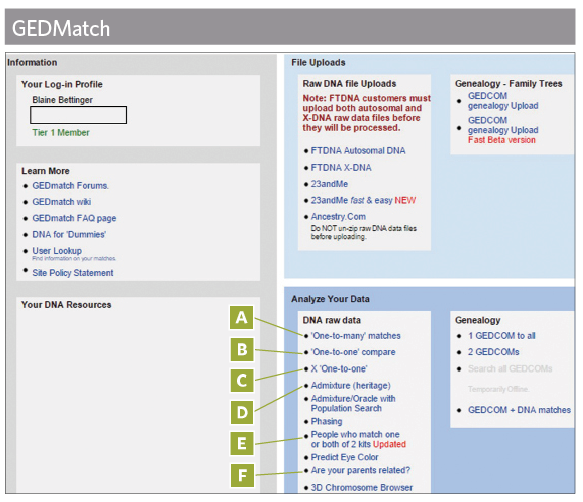
A. "Ane-to-many" matches: These compare the raw information of a single kit to the raw data of every other kit in the GEDmatch database in order to identify genetic cousins who share an amount of DNA above the sharing threshold. The sharing threshold, which you lot can manually conform college or lower, is 7 centimorgans (seven cMs), pregnant that two individuals must share a segment of Dna that is 7 cMs or longer in order to be identified as a genetic cousin using this tool. Come across pages 59 and threescore for steps to use this and the One-to-I tools.
B. One-to-1 compare: This compares the atDNA data of a single kit to the atDNA data of one other kit to identify segments of atDNA shared between the kits above the sharing threshold. Yous can manually suit the sharing threshold to be college or lower than the default 7 cMs.
C. X i-to-one: This compares the X-chromosomal DNA (Ten-DNA) information of a unmarried kit to the X-Deoxyribonucleic acid data of 1 other kit in order to identify segments of 10-DNA shared between the kits above the sharing threshold. Again, the default is 7 cMs, which you can adjust. X-DNA is on the X-chromosome. Every man has one X chromosome, inherited from his female parent; every woman has ii X chromosomes, i from each parent. This inheritance pattern can brand X-chromosome analysis complicated, then you'll want to consult resources such every bit my aforementioned book The Family unit Tree Guide to Deoxyribonucleic acid & Genetic Genealogy and the International Society of Genetic Genealogy Wiki.
D. Admixture: In this procedure, the site performs an ethnicity analysis of atDNA data using one of several different ethnicity calculators. You can view results in various formats, including every bit percentages, in a chromosome browser or as a pie chart, amidst others.
E. People who lucifer one or both of two kits: This assay uses 2 kit numbers to identify genetic cousins above a sharing threshold in three different categories: 1) Kits in the GEDmatch database that match both of the 2 entered kit numbers; ii) Kits in the GEDmatch database that lucifer just the first of the two entered kit numbers; and three) Kits in the GEDmatch database that match only the second of the ii entered kit numbers. If you lot entered your kit number and your mother's kit number, for case, you could observe 1) matches you both share; 2) people who lucifer yous but not your mom (and thus may exist related on your dad'due south side); and 3) people who match your mom but not you.
F. Are your parents related?: This determines whether a kit has whatsoever segments of atDNA that are the same from both parents, meaning both copies of a chromosome take the same DNA—and were inherited from the same antecedent—at that location. This can occur if the parents are related.
Genetic genealogists interested in learning more almost their atDNA test results should experiment with the tools at GEDmatch and go on checking back as the site continues to grow and develop new tools and functionality.
DNAGedcom
Rob Warthen launched DNAGedcom in February 2013 with tools assuasive users to download important data files from 23andMe and Family Tree Deoxyribonucleic acid. It also has tools for comparing GEDCOMs (computer files containing your family tree data), performing ICW analysis and triangulating Deoxyribonucleic acid results.
Once you've created a free DNAGedcom account, y'all can perform analyses with information from each of the 3 testing companies, plus GEDmatch. You can download Family Tree Deoxyribonucleic acid data from that visitor's website by hovering over Family unit Tree Deoxyribonucleic acid on the DNAGedcom main menu, clicking Download Family Tree Deoxyribonucleic acid Information, and entering your Kit number and Family Tree Dna password. Similarly, uploading information from GEDmatch is relatively straightforward—simply hover over Dna kits on the main page, so click Upload GEDmatch Dna Data (Beta). The GEDmatch Client, software that downloads your DNA results from AncestryDNA or 23andMe, notwithstanding, will require you to have a paid subscriber account. The subscription ($v/calendar month or $50/year) grants yous admission to the DNAGedcom Client. Find it by hovering over either Dna Kits or 23andMe. For more on downloading and using the awarding, see DNAGedcom's guide.
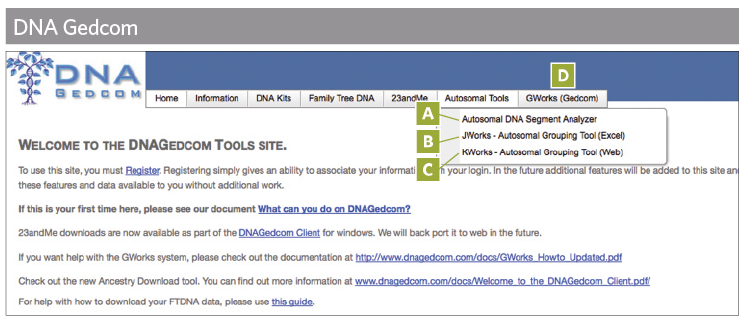
Once you've uploaded your data, you'll take access to several tools, including:
A. Autosomal DNA Segment Analyzer: This tool uses Family Tree DNA or GEDmatch data to generate tables of information on your matches, DNA segments and ICW matches. Yous so can triangulate matching segments amid groups of iii or more than people, although as explained in the Autosomal DNA Segment Analyzer quick guide on page 61, this tool doesn't provide "perfect triangulation."
B. JWorks: This downloadable Excel tool creates a spreadsheet of overlapping segments and your ICW condition amongst your matches, which helps identify potential groups for triangulation. ICW condition refers to whether one of your matches shares Deoxyribonucleic acid with another of your matches, usually indicated by an X. The tool requires three things: (one) chromosome browser data (segment data); (two) a full match listing; and (3) ICW status.
C. KWorks: This tool generates a spreadsheet of overlapping segments and ICW status among matches, which helps place potential triangulation groups. KWorks is the online version of JWorks, and KWorks requires the aforementioned three components.
D. GWorks: This tool compares family unit tree information to place shared ancestors. GWorks can likewise sort and filter tree information and perform Boolean searches of the copse. It can use GEDCOMs uploaded by the user, family tree data downloaded from matches at AncestryDNA using the DNAGedcom Customer (or the AncestryDNA Helper, another third-political party tool bachelor to test-takers), and family tree data downloaded from matches at Family Tree Deoxyribonucleic acid using DNAGedcom'southward Download Family Tree Deoxyribonucleic acid Information tool (located under Family Tree DNA> Download Family Tree Dna Data). For more data about GWorks, see DNAGedcom's guide.
The programmer behind DNAGedcom constantly improves existing tools and develops new ones. As with GEDmatch, y'all'll want to monitor this and other 3rd-political party tools to stay abreast of changes.
While the analysis tools offered past DNA companies tin sometimes be limited in their scope and utility, applications created past companies such as GEDmatch and DNAGedcom can provide valuable information and the power to compare your Dna to results from different testing companies. The new information and connections you uncover might exist the key to unlocking a family mystery.
A version of this article appears in the October/Nov 2016 issue of Family unit Tree Mag.
DNA Testing Company Blogs
Family unit Tree Deoxyribonucleic acid
Ancestry
MyHeritage
23andMe
LivingDNA
While a web log may seem like yet some other way for major genealogy companies to marketplace themselves to their customers, your research benefits when you bookmark the web log of your Dna testing company. Here's a few reasons why.
1. Get explanations of updates.
As nosotros all know, technology evolves at a fast rate, especially relevant to Dna testing and online genealogy. A constant stream of updates and refinements affects your DNA test results, equally well as the improver of more people's DNA profiles to the testing company'south database. Companies volition often weblog about recent updates and provide further explanations which can help answer questions you may accept when your data changes.
This as well goes for full general company updates, including changes in leadership or business concern policies. Here's an example from Ancestry's blog, in which the company announced its updated privacy policy.
"One advantage to reading DNA companies' blogs is that they explain the technology and algorithm updates that can alter what your examination results look like (so, you used to have Greek and Italian, and now you have "Europe S," or maybe your afar matches suddenly dropped off your list)."
Diane Haddad, Former Family Tree Mag Editor
two. Learn more than ways to utilize your test results.
Another reward to following industry blogs is learning new ways to use or interpret your DNA test results. Companies are constantly updating their websites' advent and adding new tools to help customers explore their genetic genealogy. These posts provide quick tutorials of new features that save yous the trouble of clicking around and trying to figure it out for yourself. For example, MyHeritage posted a tour of its Ethnicities Around the Globe characteristic, which allows you to explore the ethnic makeup of dissimilar countries.
Visitor blog posts can help inform you of means to utilise your DNA that yous might non otherwise know most, helping you dig deeper into the information available.
three. Discover sales and genealogy record offers.
Of course, companies volition use their blogs to promote their services and products, but this can give genealogists a way to stay on height of new record releases, special sales and discounts. Fold3, the military machine records site Beginnings runs, is peculiarly adept about blogging when they are offering free access to records and having subscription sales. If you've got service members in your family unit tree, this blog would be a good way to stay updated on coin-saving enquiry opportunities.
4. Read great stories.
Finally, genealogy industry blogs tin be a swell place to find inspiring and uplifting stories about researchers who make family connections. This appears to be the direction that Family Tree Deoxyribonucleic acid is taking with its blog so far, featuring stories nearly customers who were reunited with long-lost family members or who made unexpected discoveries when researching their family trees. This results in a curated feed of happy, inspirational genealogy stories for when yous need a fiddling adept news. Still, the greatest do good of these stories isn't the feel-good role, merely the example of tried-and-truthful tips and strategies that you can use to your own enquiry.
Related Reads

On these genealogy and family history websites, yous can search databases of ancestor names and digitized records—and it'due south all free.
Not sure what to practise now that you lot have your DNA test results? Nosotros'll outline three "next steps" to aid y'all use your results to make new genealogy discoveries.
Get Your Free Essential Genealogy Research Forms
Sign upward for the Family unit Tree Newsletter and receive 10 enquiry forms as a special cheers!
Get Your Free Genealogy Forms
"*" indicates required fields
Source: https://www.familytreemagazine.com/websites/free-dna-genealogy-websites/
0 Response to "How to Upload Family Tree Dna to Ancestory"
Post a Comment