Is the Artctic Ice Shelf Growing Again
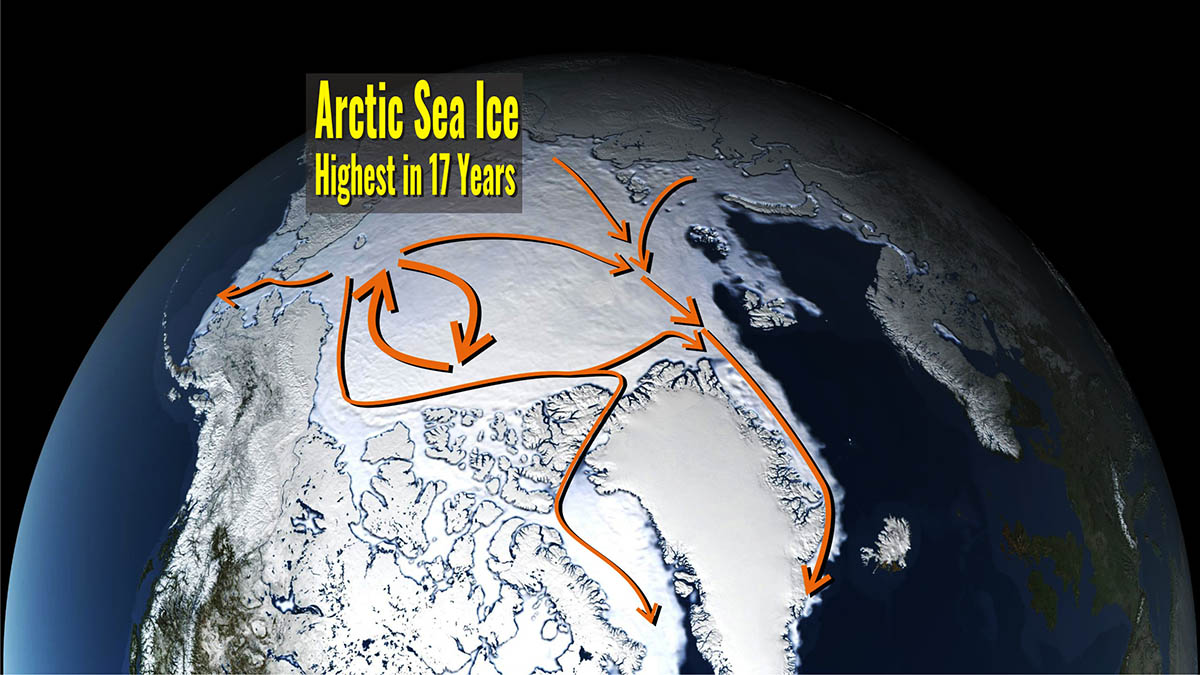
Arctic sea water ice extent in January 2022 kept growing at a decent rate, and it is actually the highest in the concluding xiv years, co-ordinate to the Us Snow and Ice Data Eye. A cool summertime and autumn, particularly in the western Arctic Body of water, led to a rapid increase in bounding main water ice early this year. A marked negative anomaly is instead affecting Antarctic coasts. Here, body of water ice extent is shut to that of 2017, which is the everyman on record.
ARCTIC SEA ICE JANUARY 2022
The Arctic sea ice extent really grew faster than in the latest years. On average, in January its extent was thirteen.88 million foursquare kilometers (v.36 million square miles) which is well within the interdecile range according to the Chill Data archive Organization, NIPR.
The interdecile range is a measure of statistical dispersion of the values in a set of data. This means although below average, it is actually within the normal bounding main-ice inter-annual variability. The magenta line in the image below shows 1981 to 2010 average extent for that calendar month.

At the finish of January, the sea water ice extent which defined the expanse of the ocean with at least 15% ice was well above xiv million square kilometers. But, what is almost important, although such extent represents the sixteenth-lowest in the satellite record starting in 1979, information technology is actually the highest in 14 years, precisely since 2009.
This testify shows the large natural variability in sea water ice weather, but indeed represents an important indicator of current conditions and possible feedback in the upcoming Spring season. Nevertheless, we want to stress that winter ice extent is a weak indicator of what the water ice extent volition look similar this coming September when we will confront the annual minimum.

In the video nosotros set up beneath, you can track sea ice extent evolution in the Arctic updated every 5 days from January i to Jan 31. Arctic sea water ice grows constantly but remains below normal mostly in the Ocean of Okhotsk and in the Barents Sea.
Although sea ice is relatively all-encompassing compared to recent winters, it remains relatively thin. In the Barents-Kara Seas extent is close to normal. Below normal body of water water ice in the Barents-Kara seas favors cold temperatures in Central and East Asia, however, this topic remains controversial. Further down we will expect at the sea ice extent in each and every sector of the Arctic.
Along with body of water ice extent, in the video, in a higher place nosotros take too shown the hateful temperature of the ice and the surface of the sea based on satellite observations. This datum has a bang-up influence on the substitution of oestrus between the surface and the atmosphere, and thereby besides the rate of increase of the sea ice volume.
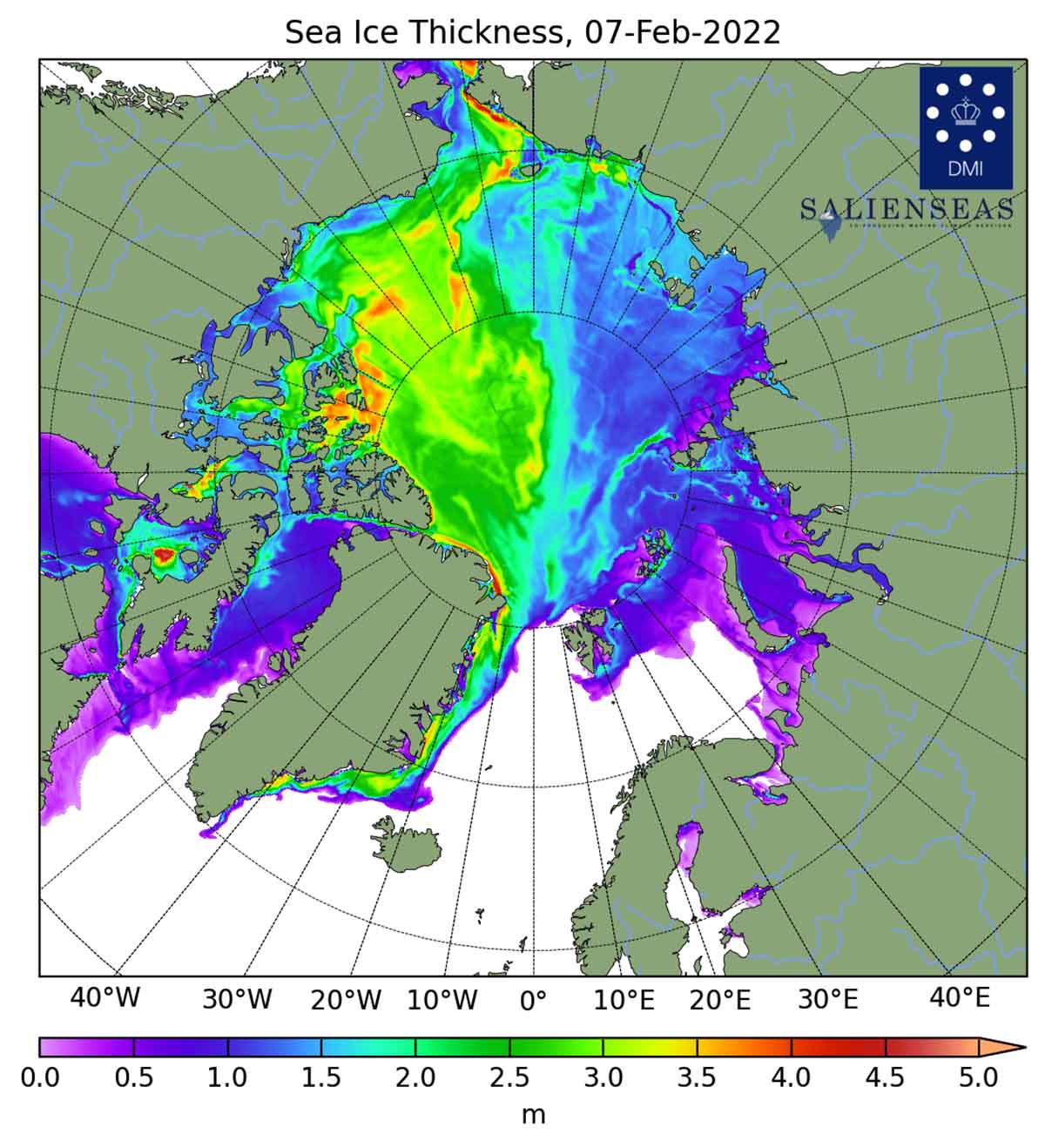
The thickness of water ice, and thus the volume, appear at the end of the video. The animation and graph illustrate the sea ice thickness in the Northern Hemisphere, excluding the Baltic Bounding main and the Pacific. The information are available thanks to the DMI's model calculations through the Polar Portal
The image below shows body of water ice extent and thickness on February 7, 2022.
WHAT SEA ICE IS?
Sea water ice means all sorts of water ice that form when seawater freezes. Ice in the body of water that is non fast ice refers to migrate ice, and, if the concentration exceeds 70%, information technology is called pack ice. When sea water ice concentration is lower than 15% this is considered equally open up water, and the boundary between open water and ice is called the ice edge.
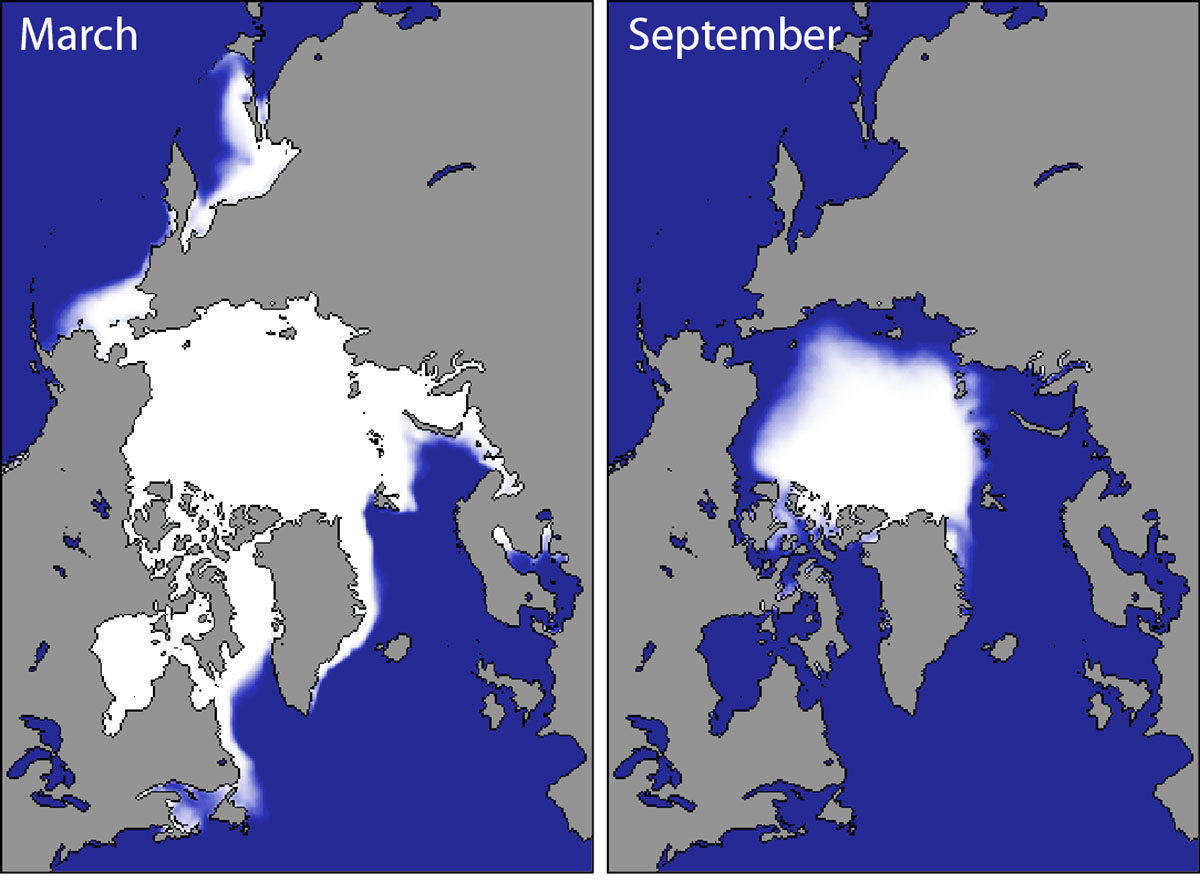
Ice extent in the Chill Ocean grows throughout the wintertime and peaks in March. In September the extension reaches its minimum, which is generally only around one-third of its winter maximum. In guild to go a proper picture of the bounding main ice state, there is the need of determining both extents and volumes. Such numbers primarily include the ice thickness, generally linked to the historic period of the ice. In the image below, Arctic sea ice climatology from 1981-2010 by the Snow and Water ice Data Center, University of Colorado, Boulder.
As we stated a few paragraphs above, wintertime ice extent is a weak indicator of what the water ice extent volition look like this coming September when we will face the annual minimum. The seasonal bicycle of Arctic bounding main water ice is characterized by the maximum almanac extent in March, decreasing through bound and summer to an annual minimum extent in September.
Since 1979 it has been possible to monitor sea ice past satellite. At present, We have 43 years of reliable data on the extent of the body of water ice cover. The bounding main water ice had continuously diminished and particularly since the end of the 1990s. Notwithstanding, the wintertime tendency is different from the summer trend.
In the image beneath the Arctic body of water ice extent development at the end of the winter season (March maximum) and by the end of the summer (September minimum)

Equally global temperatures rise, Chill sea ice extent, and book too, have shrunk past an boilerplate of 13.4% per decade since 1979. The ice that remains is frequently thinner and more fragile than before, making it more vulnerable to melting the post-obit year.
The animated time series below in the video we prepare for you lot, we nowadays the annual Arctic sea ice minimum since 1979, based on satellite observations. After this, a captivating graphic past Zachary Labe shows changes in annual hateful Chill bounding main water ice extent based on NSIDC Sea Ice Alphabetize v3, and air temperature anomalies from Berkeley Earth Surface Temperature over the satellite era.
THE Electric current ANOMALY IN THE GENERAL Competition
Looking more in detail to the electric current Chill Sea Ice anomalies referred to the long-term 1979-2022 monitoring, nosotros utilize the image below credits Zachary Labe. The plot shows the extent anomalies source satellite-era, NSIDC, DMSP SSM/I-SSMIS calculated using a 5-day running hateful from a climatological baseline of 1981-2010. The year 2022 updated to February 2 is shown using a blood-red line, while 2021 is highlighted in yellow.
Although lower by about 0.5 one thousand thousand foursquare kilometers, the Arctic Sea Ice extent is non as bad as in the very last winter flavor, and definitely higher of 2021. Later a rapid melting occurred from late May to early on July 2021, the anomaly reduced through August, eventually raising over again in September and early on Oct.
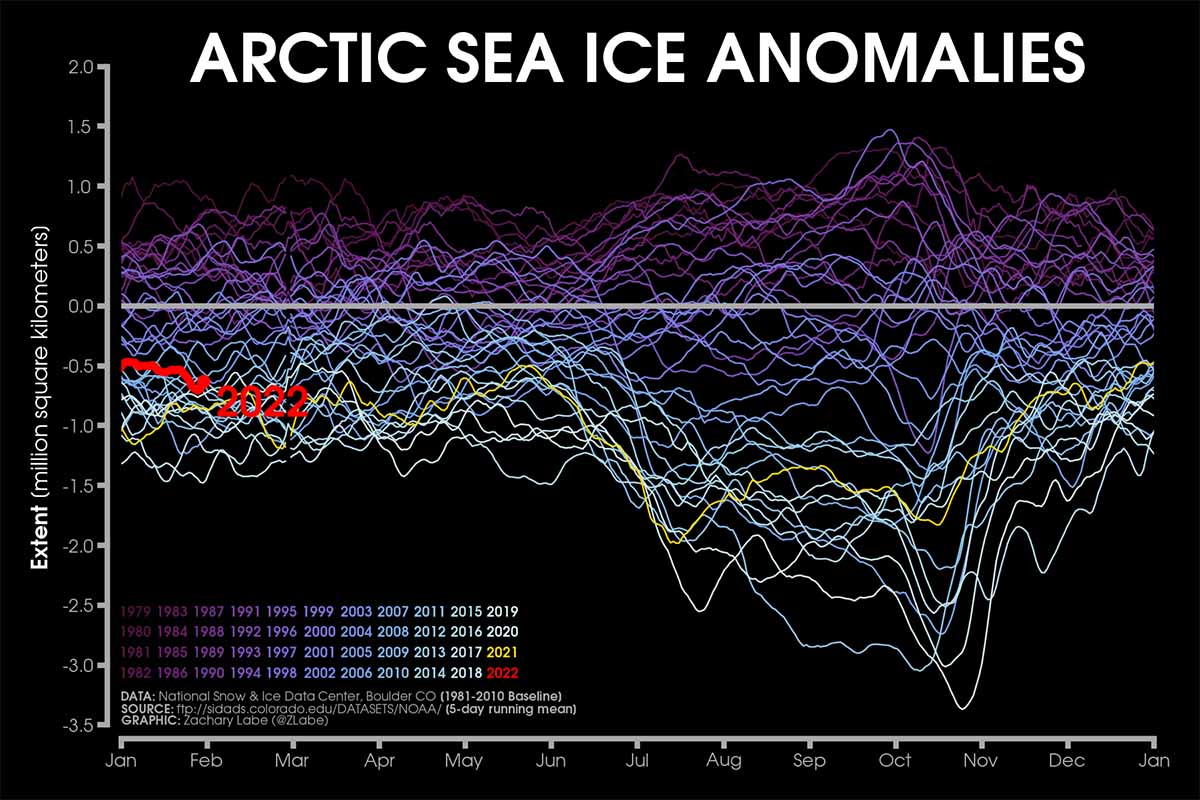
This year, extent reached its minimum on September 16th but it was far from the lowest on record and was really simply the 12th lowest in the past decades. A colder than average weather condition in the western Arctic Body of water slowed downwardly sea ice from melting particularly in the Canadian and Alaskan regions.
Yet, the 2021 minimum sea ice extent was effectually 4.724 million square kilometers, roughly i.6 million square kilometers lower than the long-term mean. Non merely air temperature, but sea temperature likewise were colder than normal in the western Chill sector last summer. This was certainly a favorable trigger contributing to fast and earlier freezing in this Arctic sector when the fall season started.
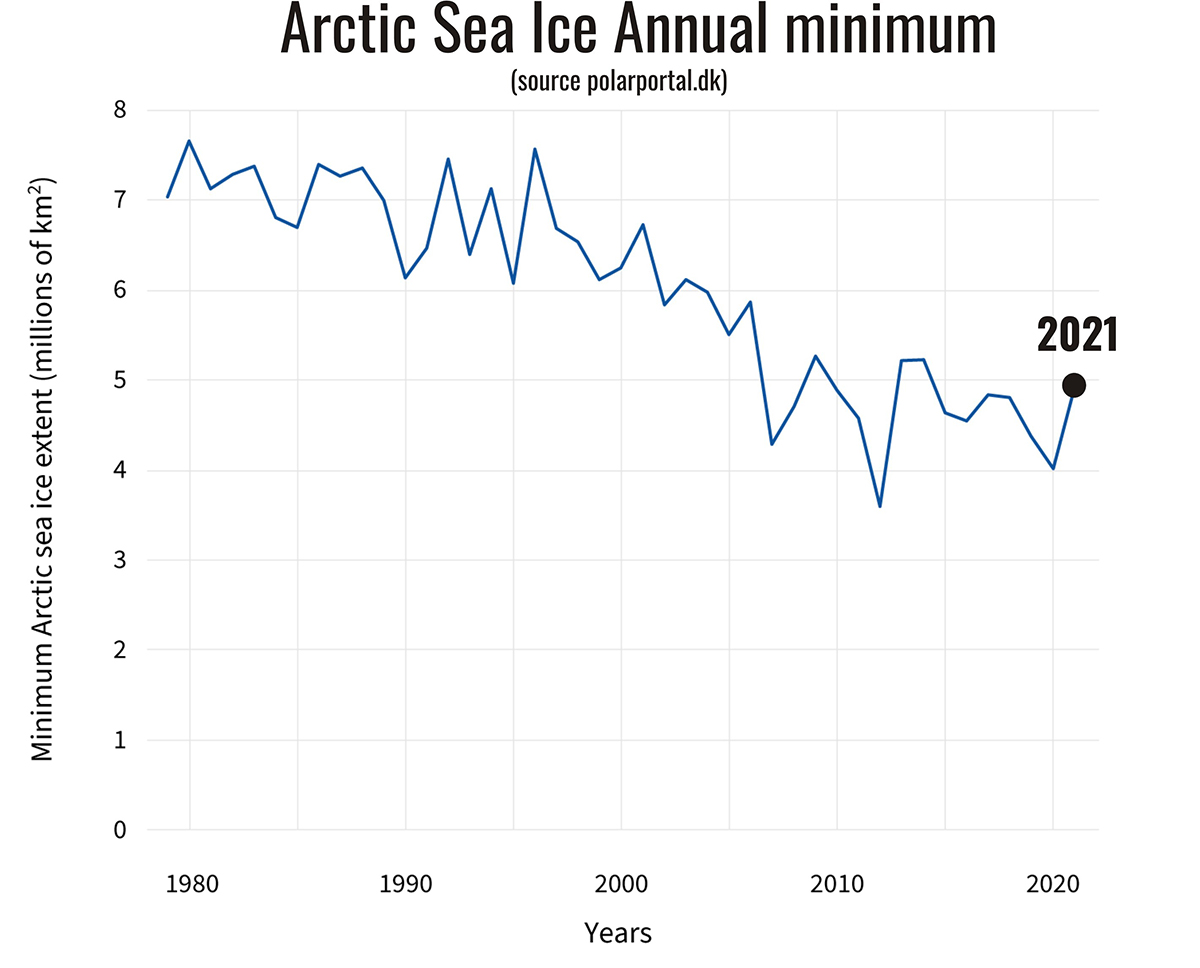
At this point of the season, the Arctic ocean ice extent is nonetheless growing and it volition keep to do so until about mid-March. Nonetheless, it remains below normal generally in the Sea of Okhotsk and, recently, in the Barents Body of water. Overall we saw that ocean ice is relatively extensive compared to contempo winters, though it remains relatively thin.
In the Chucky and Kara Seas extent is close to normal. Below normal sea ice in the Barents-Kara seas plainly favors common cold temperatures in Cardinal and Due east Asia, nonetheless, this topic remains controversial. The extent is recently close to normal in the Greenland body of water too, thanks to a rapid increment in the second role of January triggered past a favorable conditions pattern.
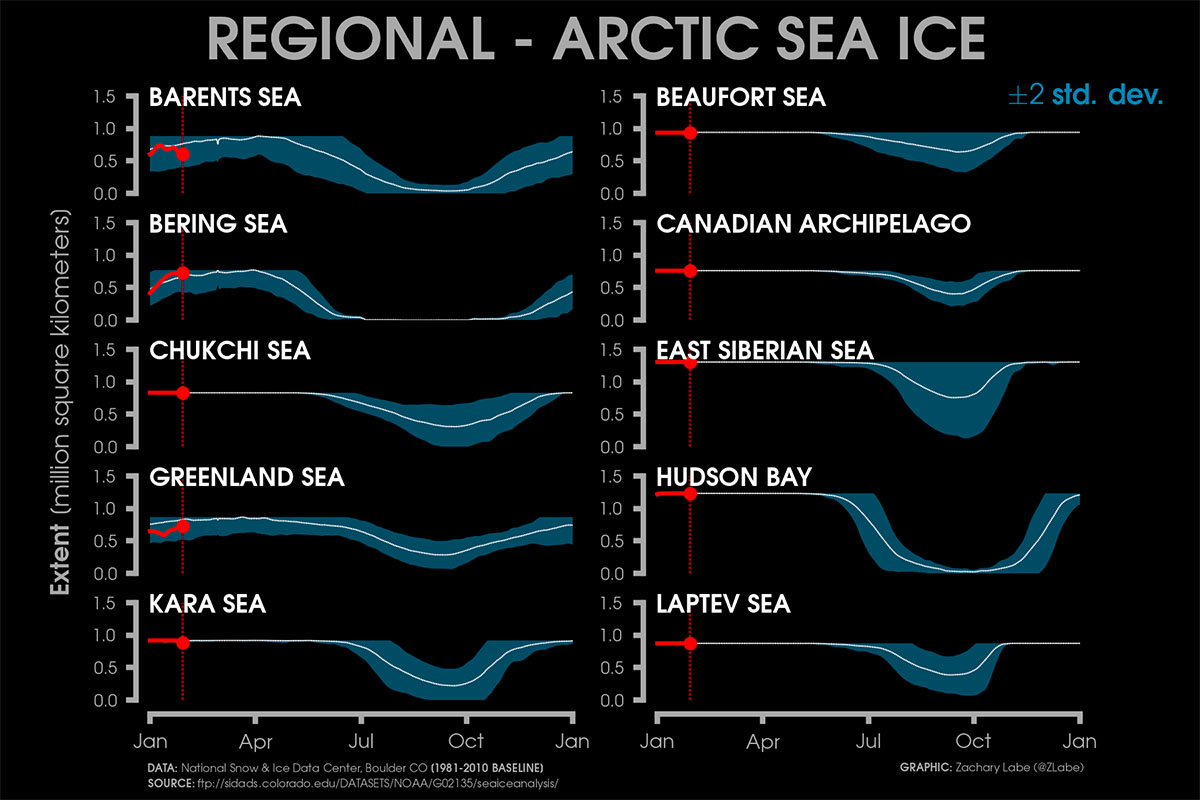
In the image to a higher place, (updated February vii, 2022) the electric current regional Arctic sea ice extents thanks to NSIDC Bounding main Ice Index v3 in addition to 2 standard deviations from 1981-2010 hateful. In particular, the Greenland Body of water faced a fast increase in Sea Water ice extent in the second office of Jan.
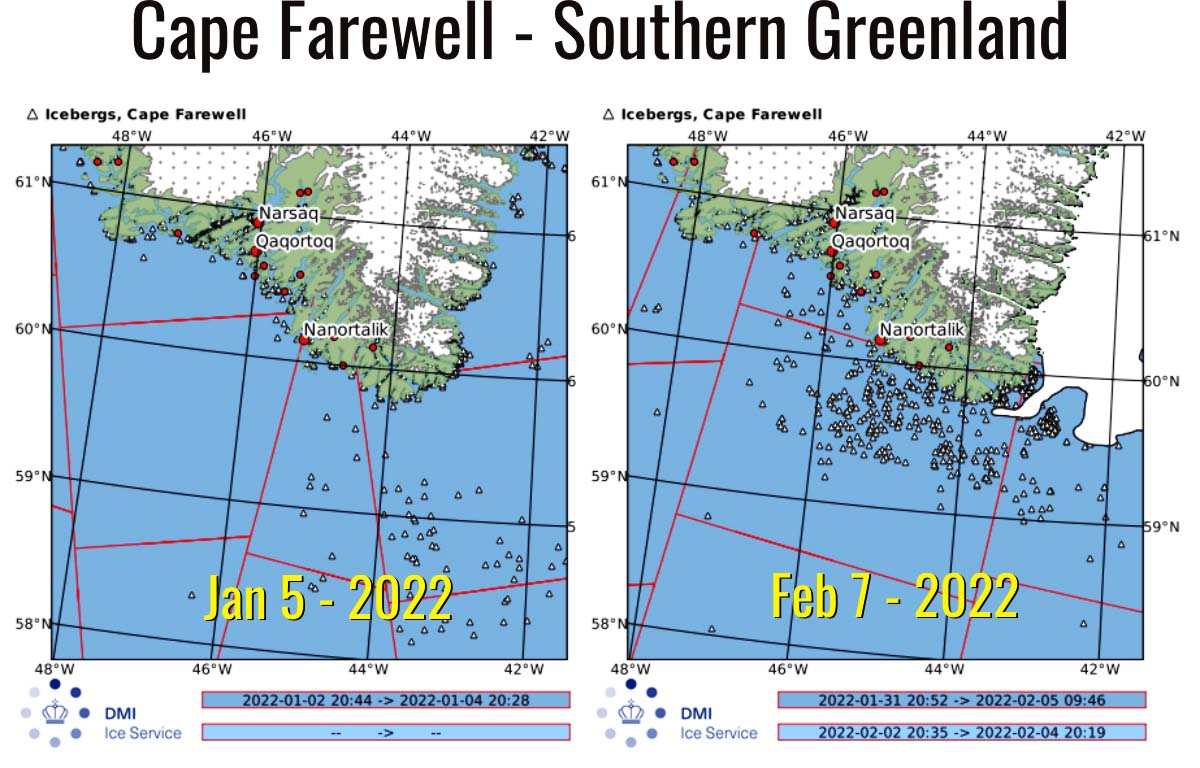
The prototype below shows how ocean ice reached Cape Farewell in Southern Greenland in the terminal weeks and how the number of icebergs increased. Until mid-January, the east coast was costless of ice. Pure white areas refer to sea water ice, while the number of icebergs is detected within the light- and night bluish surface area and presented as pocket-size triangles.
HOW WAS THE Weather condition IN THE ARCTIC IN Jan
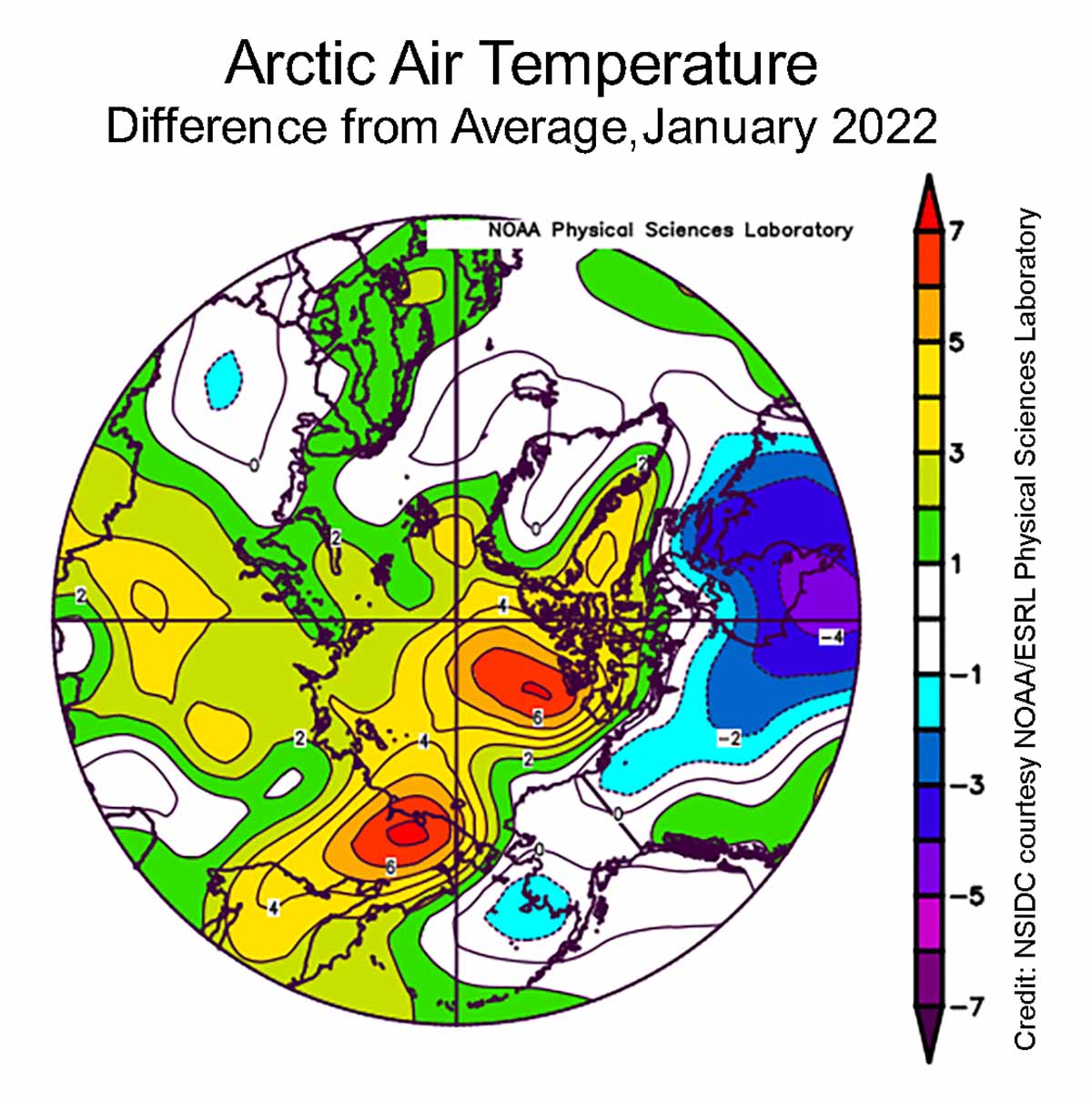
Air temperature in January at the 925 hectoPascal level, corresponding to most 700 meters or ii,500 feet to a higher place the surface, was above average over all of the Arctic Ocean. Temperatures were upwardly to seven degrees Celsius (13 degrees Fahrenheit) higher than average northward of the Canadian Archipelago, with smaller differences in other sectors.
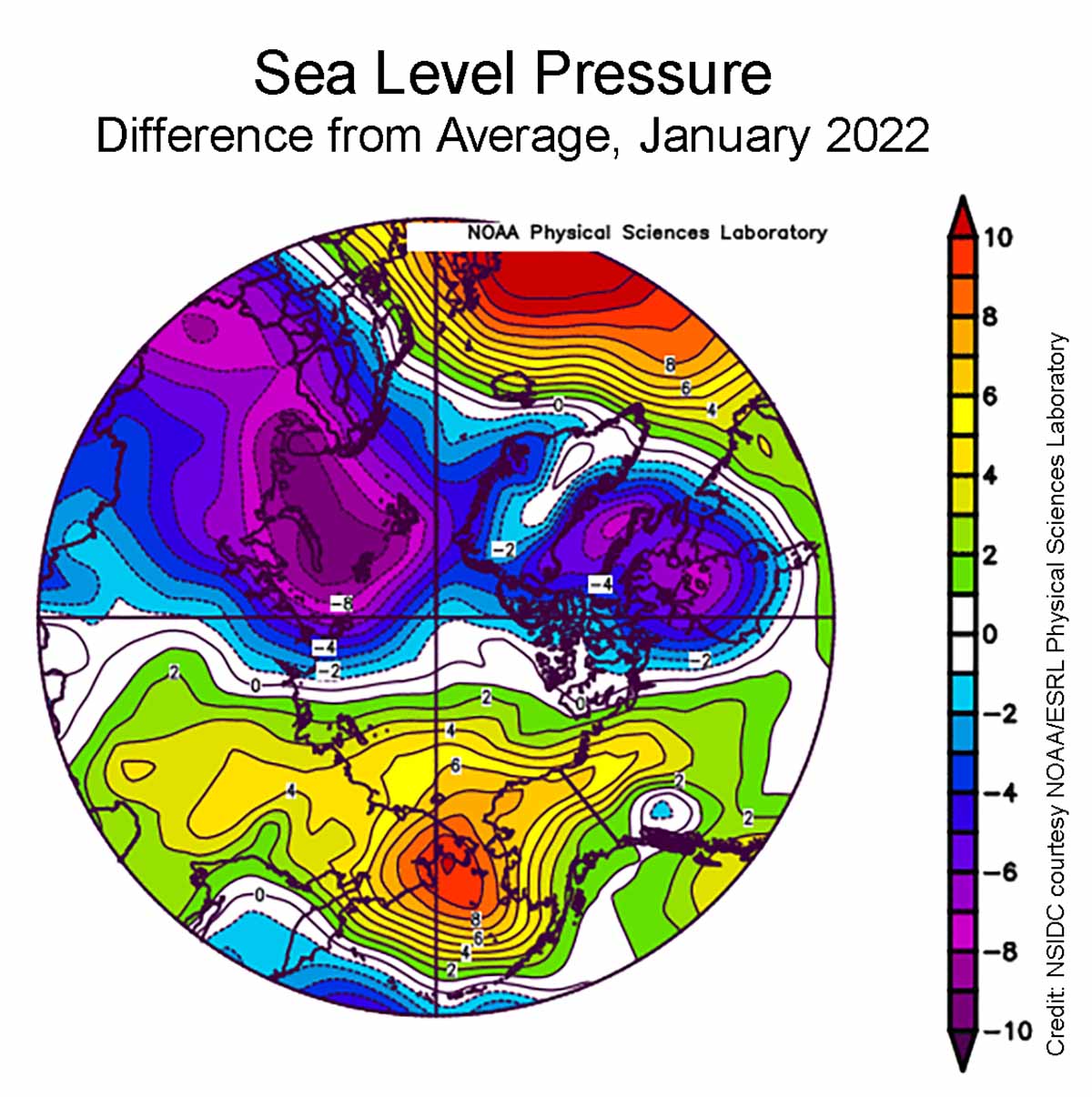
This plot below shows the difference from average air temperature in the Arctic at the 925 hectoPascal level, in degrees Celsius, for January 2022. Higher than the boilerplate air temperature in yellow and reds, dejection and purples signal lower than average values. Both temperature and pressure plots are credits NSIDC courtesy NOAA Earth System Enquiry Laboratory Physical Sciences Laboratory
Bounding main level pressure pattern January in the prototype below featured the typical Siberian High pressure usually forming over eastern Siberia in the cold flavour. Nevertheless, sea level pressure level was upwards to 8 hectoPascal above average over eastern Siberia, extending through the Bering Sea and into western Alaska.
At the same fourth dimension, below-average sea level pressure was observed over Eurasia and Hudson Bay. Typically, when the Siberian High is potent, an advection of warm air from eastern Europe leads to balmy weather condition over the Kara and Laptev Seas. The Siberian High was too accompanied by low pressure s of the Aleutians.
This blueprint triggers winds transporting cold air that additional freezing weather condition in the Bering Sea and pushed water ice southward, leading to a college ocean ice extent in the Bering sector.
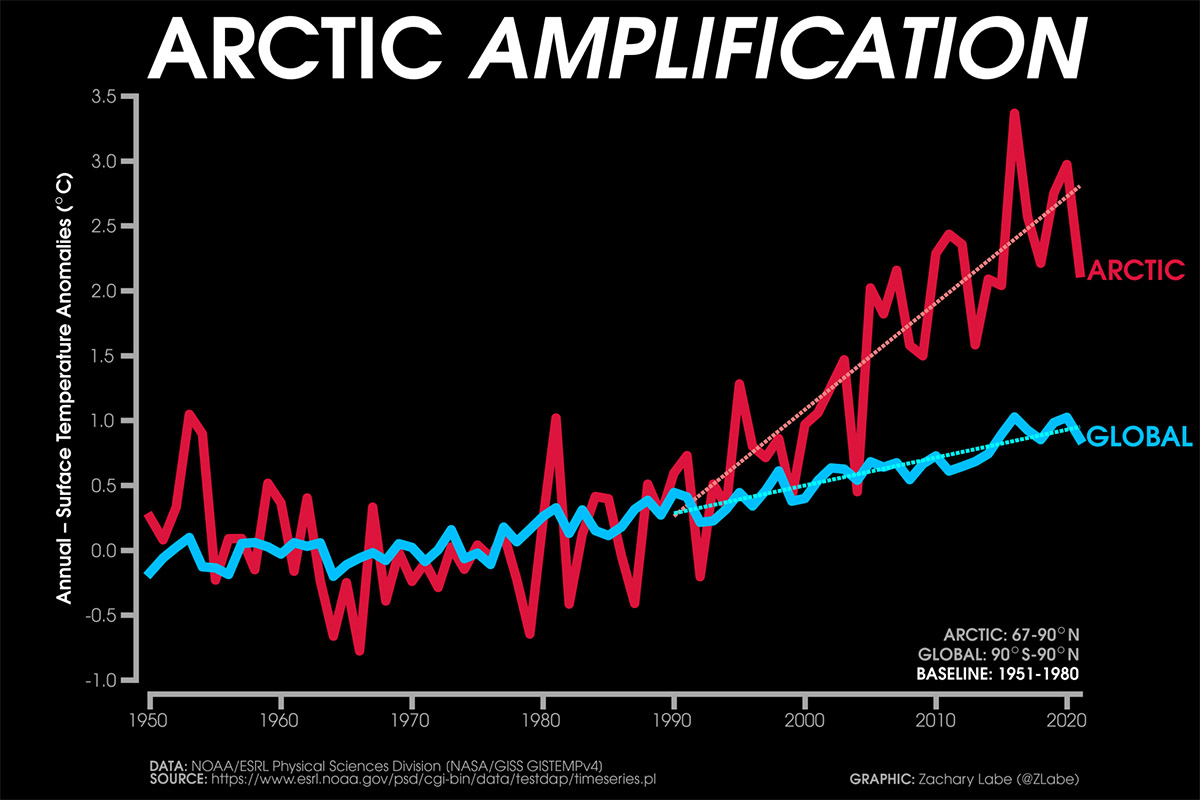
As we saw higher up, the temperature in the Arctic dramatically increased, and the warming hither drastically enhanced than globally. This is mainly due to the so-called Arctic Amplification. Arctic Amplification refers to the enhancement of nigh-surface air temperature change over the Chill relative to lower latitudes.
These mechanisms include both local feedback and changes in poleward energy transport. Temperature and sea ice-related feedbacks are especially important for Chill Amplification since they are significantly more than positive over the Arctic than at lower latitudes. Changes in albedo from a frozen light sea surface to a free-of-ice and darker ocean surface allow positive feedback affecting mean and extreme temperatures in the Arctic.
The extent of bounding main ice in the Arctic has important implications for global climate and weather, both in North America and Europe. The Ocean Ice Extent in the Arctic this year is in contrast with what is happening globally, and in detail because the Antarctic sea water ice is in sharp decline.
Although stable higher up the long-term average from March to the end of August, Antarctic Bounding main Ice started its rapid turn down in September. At nowadays, the negative anomaly is the 2d-largest ever recorded.
SUMMER 2022 IN ANTARCTICA
The Arctic and Antarctic are geographic opposites, and not just because they stand on reverse ends of the World's globe. They also take opposite land-sea arrangements. In the Arctic, continents surround an sea, while in Antarctica the continent is surrounded by oceans.
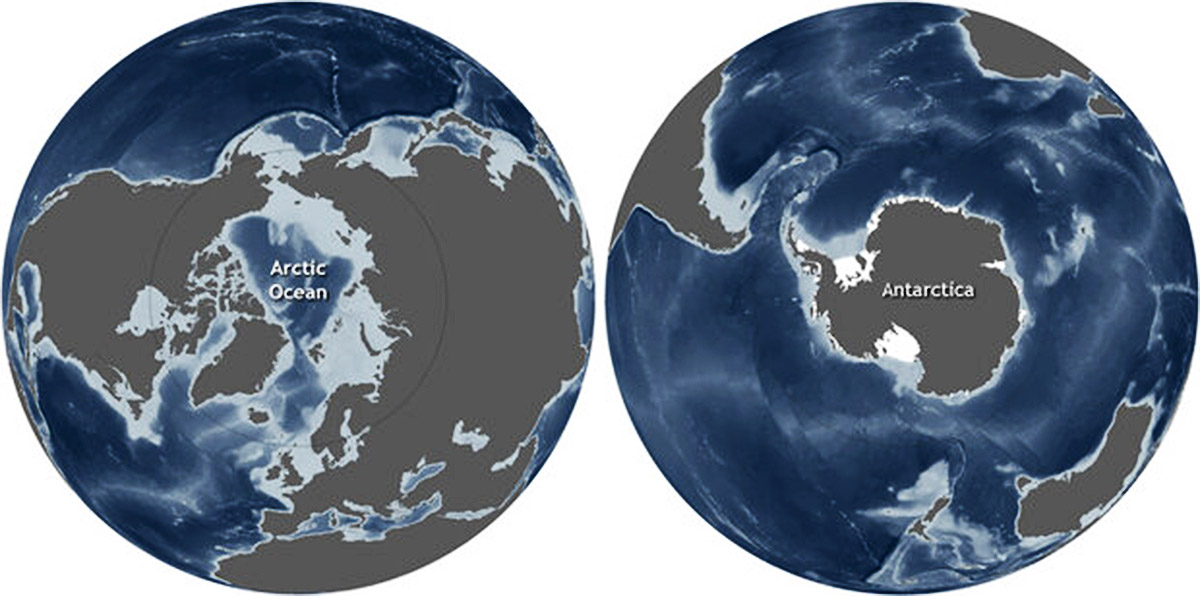
These differences in the arrangement of land and water contribute to differences in each polar region's climate, oceanic and atmospheric apportionment patterns, and sea ice.
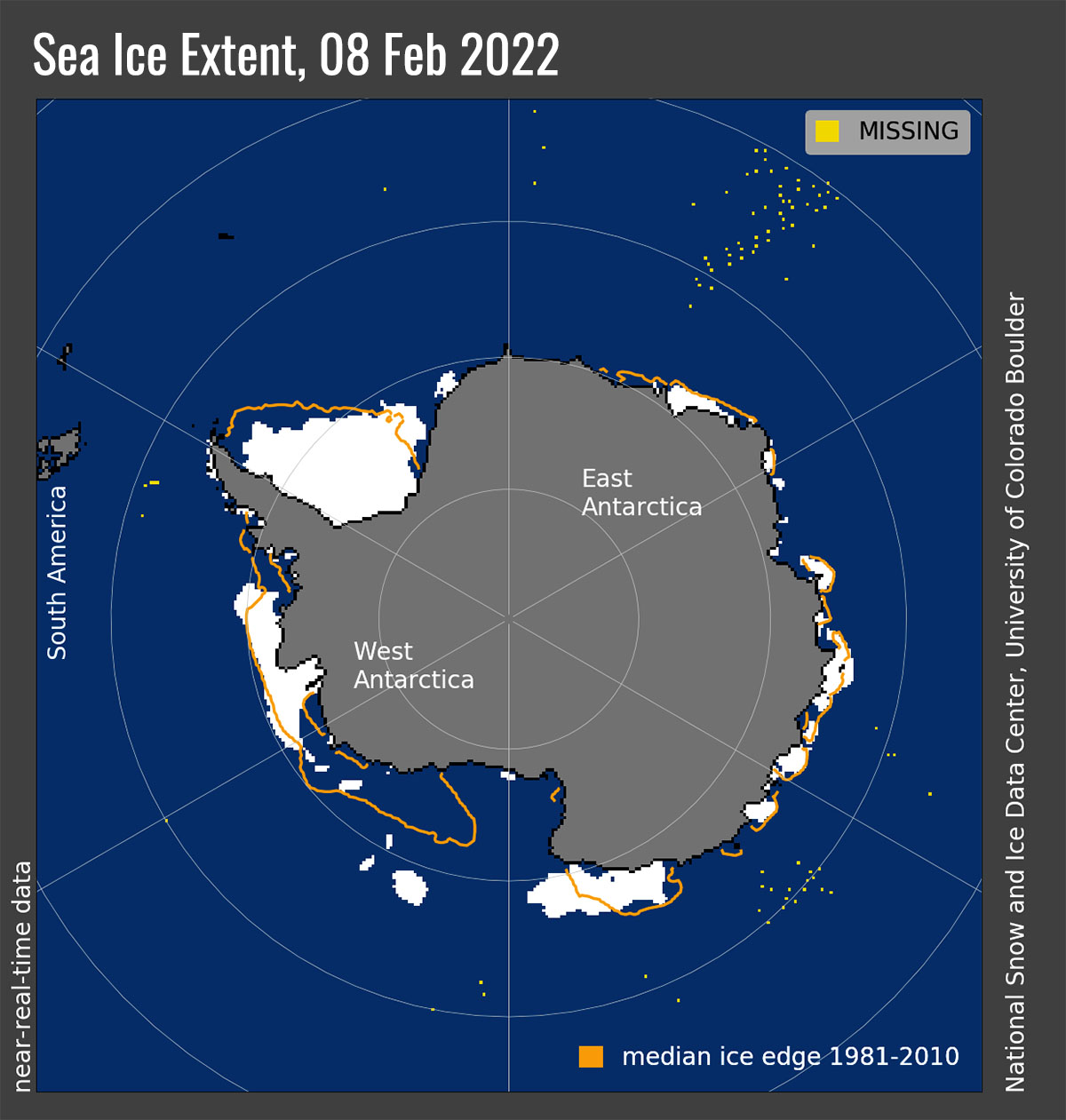
Antarctica is experiencing definitely warmer temperatures so far this year. As a consequence, in January body of water ice extent was the second-lowest in the 44-year record. The image below shows the Antarctic sea water ice extent at the beginning of Feb, along with daily water ice extent data for five previous years.
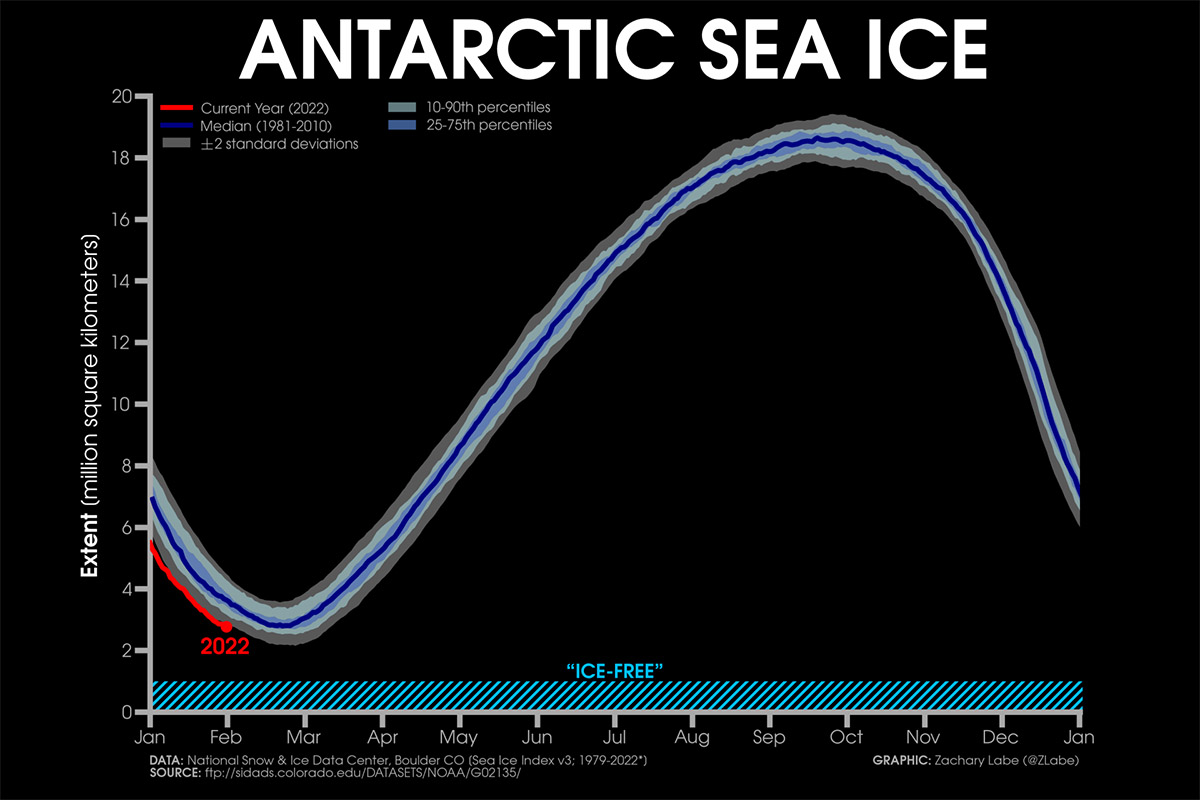
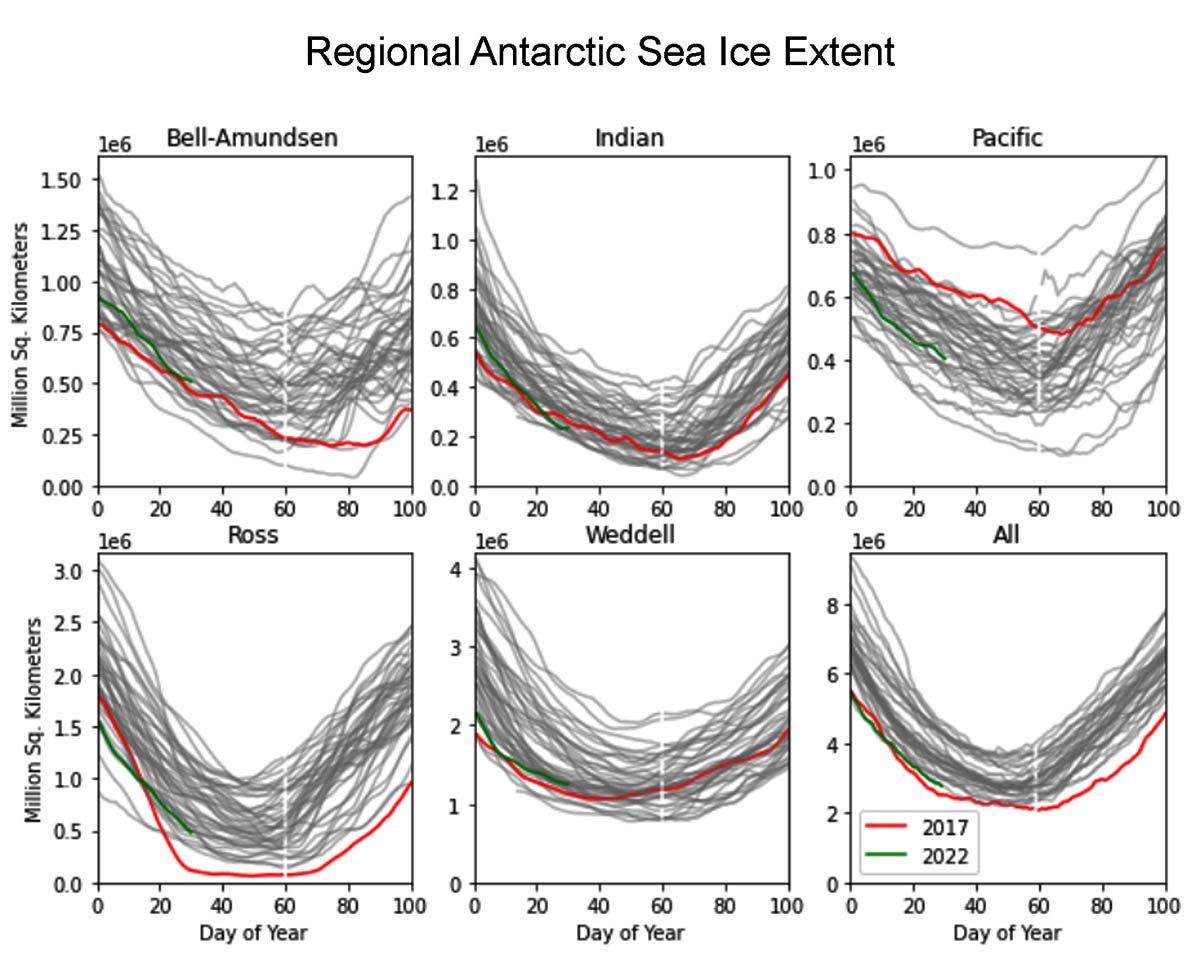
In these days bounding main ice extent is running roughly at the same step of season 2017-2018. Regionally, water ice extent is tracking below levels observed for 2017 in the Indian and Pacific sectors, but to a higher place levels for that year in other sectors.
In 2017, only the Ross Sea recorded a very low extent, therefore it was the main commuter of the record low hemispheric ocean ice extent. As well, in 2021-2022 summer none of the specific regions have record low extents, but all are well below average leading to the second-lowest Antarctic sea ice in the satellite tape, to a higher place 2017.
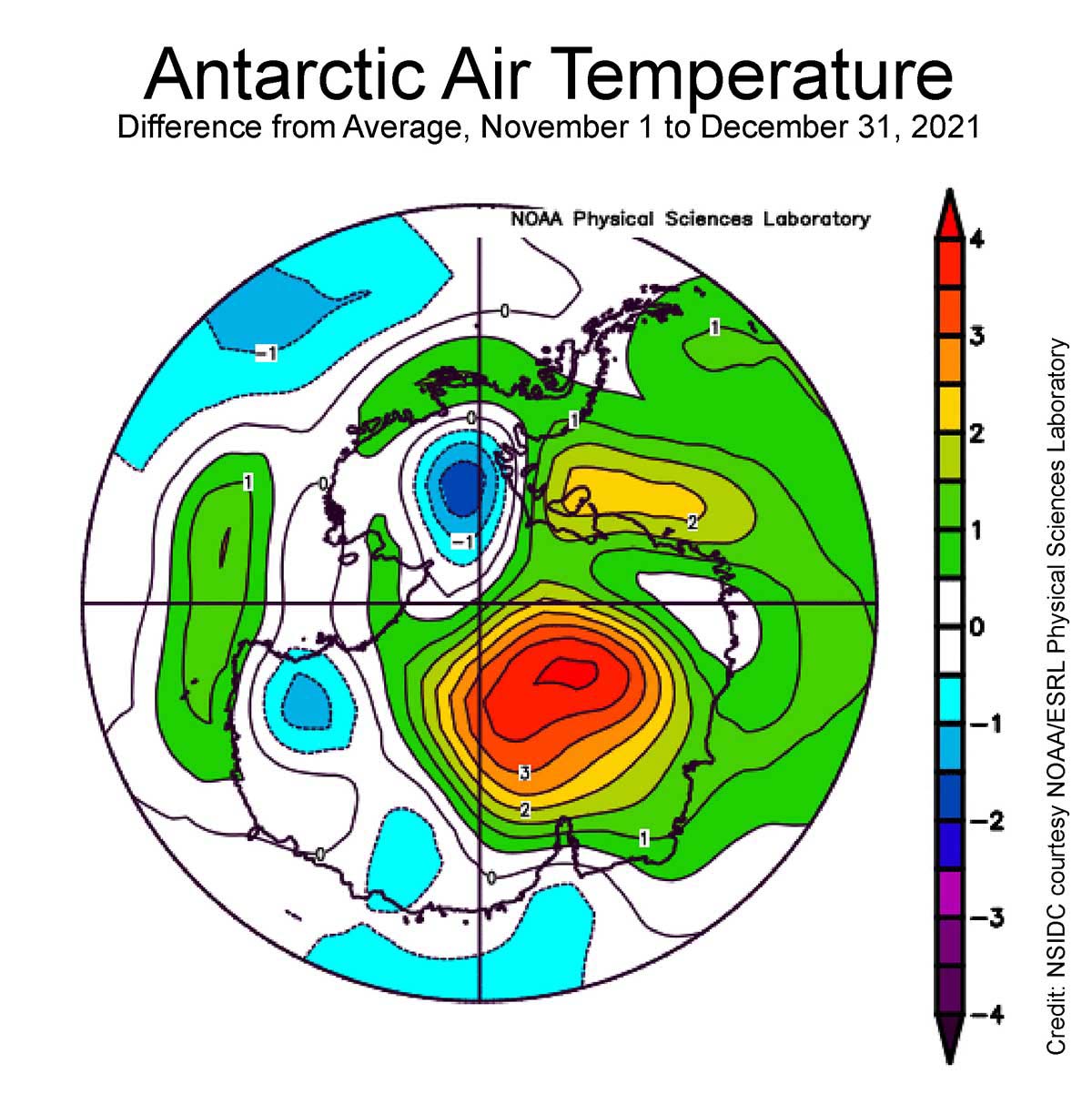
In the image below the average temperature for November and December shows a massive positive anomaly upwards to 4 °C in a large part of Antarctica. The prototype shows the divergence from mean air temperature, in degrees Celsius, at the 925 hPa level. Yellows and reds point college than average temperatures; blues and purples point lower than average temperatures.
The interior of the East Antarctic Water ice Sheet was rather warm but does not arroyo the melting temperature. On the other side, in coastal areas temperature approaches more than easily and frequently the melting point during the summer season.
In the paradigm below, the number of melt days between November one – Jan 9, 2022. The boilerplate values and ranges for the 1990 to 2020 reference period. Credit L. Lopez, NSIDC, M. MacFerrin, CIRES, and T. Mote, Academy of Georgia. The northern part of the Antarctic Peninsula experienced the higher numbers of melt days
The northern function of the Antarctic Peninsula was affected by a series of recursive melting peaks that occurred in December and in Jan, causing farthermost melting well in a higher place the long-term average. Such events accept been amplified by severe foehn wind events.
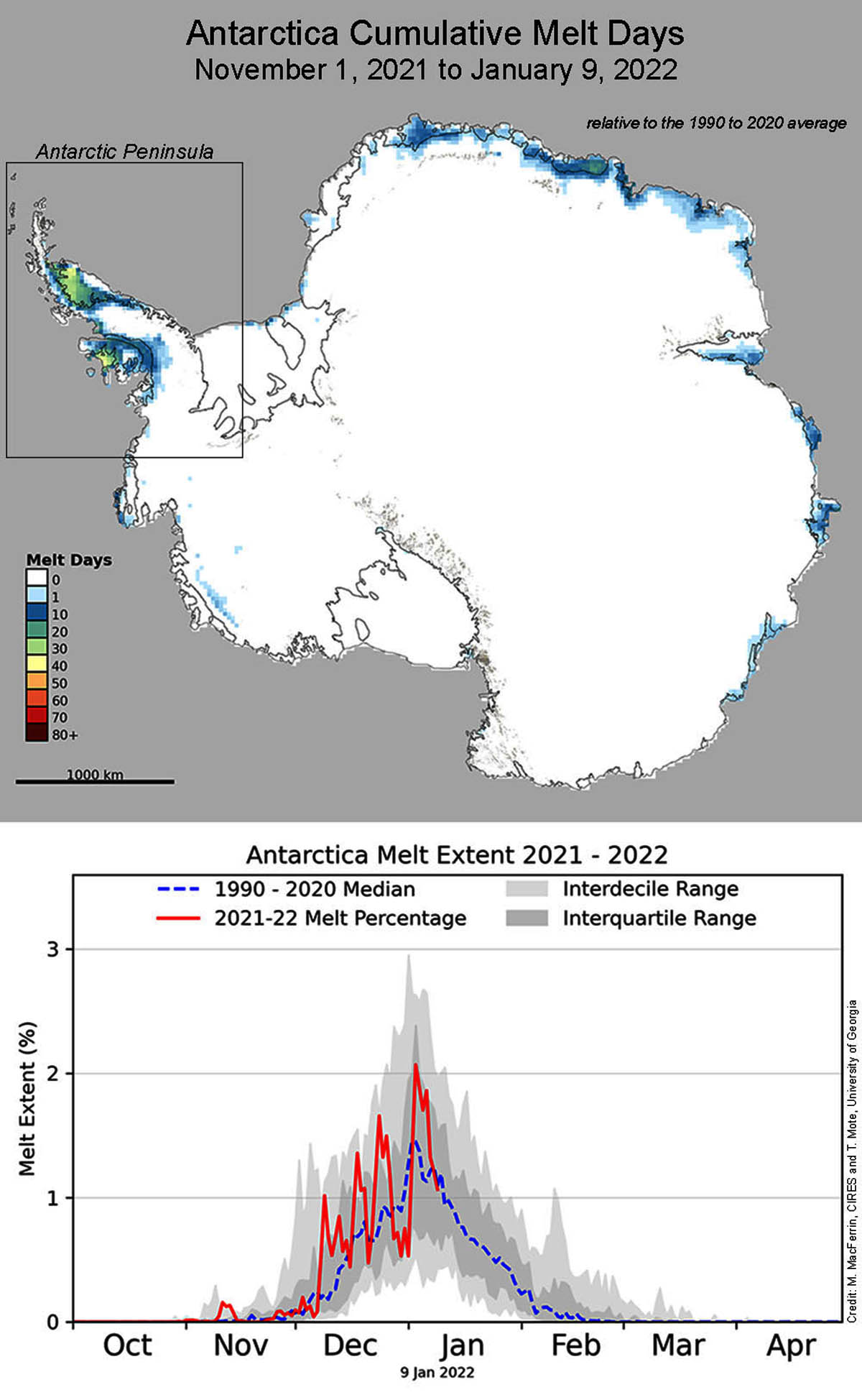
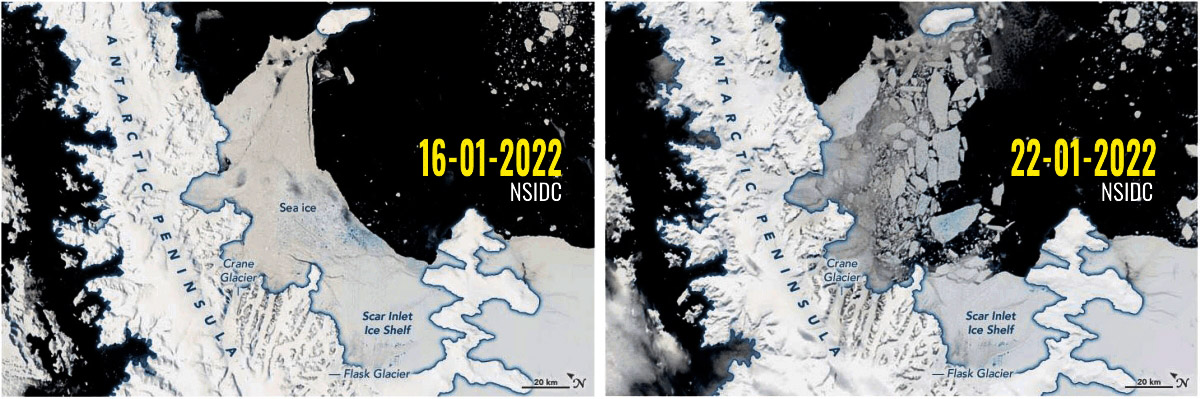
As a issue, multiyear fast ice in the Larsen B embayment, in place continuously since early 2011, showed widespread meltwater flooding with some deeper ponds and some areas tuckered past narrow fractures. Betwixt January 16 and the 21st, the body of water water ice of the Larsen B ice shelf, linked to the Antarctic Peninsula'south, crumbled and disintegrated.
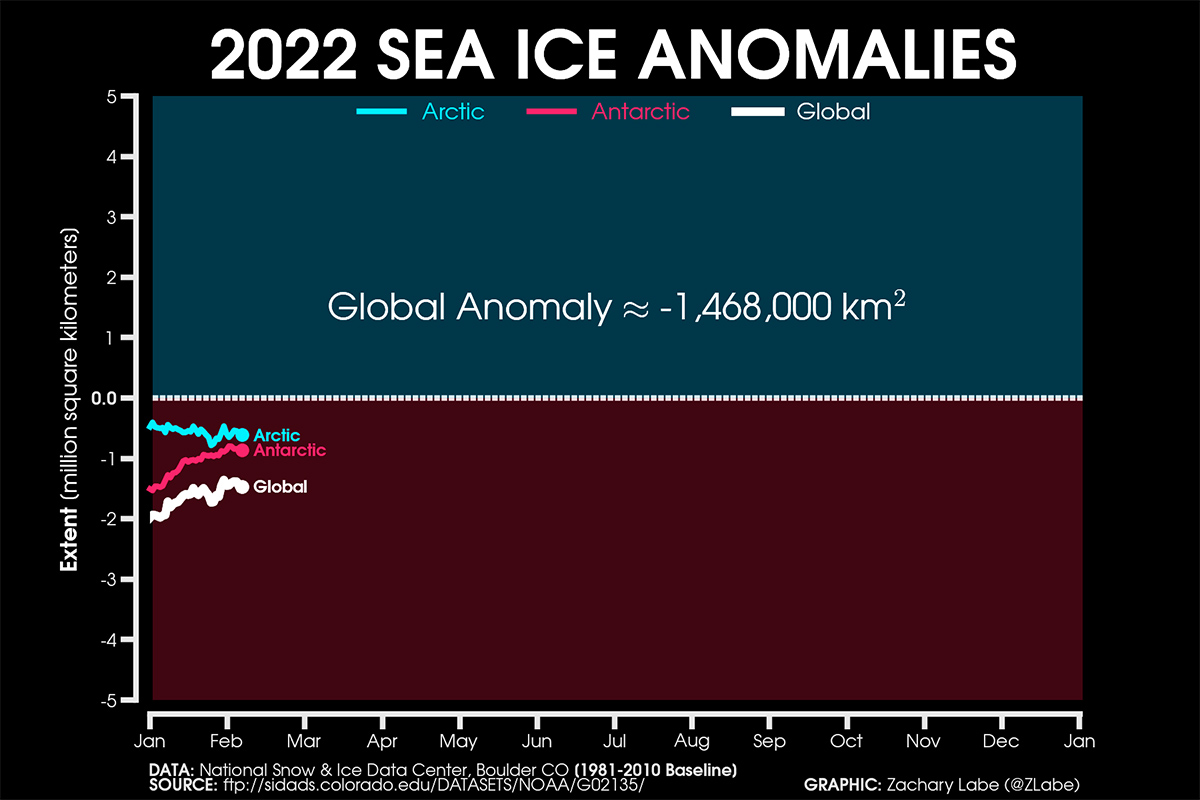
Both the Chill and Antarctic Sea Ice extent button the global bibelot at -1.468 million square kilometers or about 0.567 million square miles. In the paradigm beneath the current bounding main ice extent anomalies for the Chill and Antarctic, source NSIDC, DMSP SSM/I-SSMIS F-18 edited by Zachary Labe. Anomaly is based on 1981-2010 climatology.
We will go on you updated on this and much more, and then make certain to bookmark our page. Also, if yous accept seen this article in the Google App (Discover) feed or social media, click the like button (♥) to meet more of our forecasts and our latest manufactures on atmospheric condition and nature in general.
Source: https://www.severe-weather.eu/global-weather/arctic-sea-ice-extent-highest-since-2009-antarctic-sea-ice-all-time-low-january-rrc/
0 Response to "Is the Artctic Ice Shelf Growing Again"
Post a Comment